





Travel back in sharp, monotone time to 1983, as Southampton and its suburbs – changing skylines, busy high streets and historic villages – were photographed in a fascinating period of change.
1983 was more than just a distant year noted on a calendar, it was an era of real change recorded in indelible ways on our local environment, as can be seen in this first of two special picture galleries.
Looking at these images from the archive, you can almost hear the rev of engines negotiating Hanover Buildings and feel the tension as eager shoppers wheel wire trolleys into the new Totton Asda.
You can see the contrasting tales of a Fareham high street determined to drag itself into the modern era and the deeply preserved peace at Buckler's Hard.
From the Bitterne Park Triangle clock tower to the dizzying aerial views of an undeveloped Otterbourne and Shawford, these pictures are a vivid reminder of a place that is both barrelling headlong into the future and standing its ground proudly in the past.
Digging into the archives, as we look back at all the faces of our everyday lives from the streets we walk every day, these pictures offer the chance to revisit the moments that were eternally captured on film
Here's our first look back at those images from the archives.
Make sure to grab a copy of next week's Daily Echo for our next edition of our two-part exclusive photographic look back at 1983, when we will unearth even more forgotten snapshots from the past.
Bargate

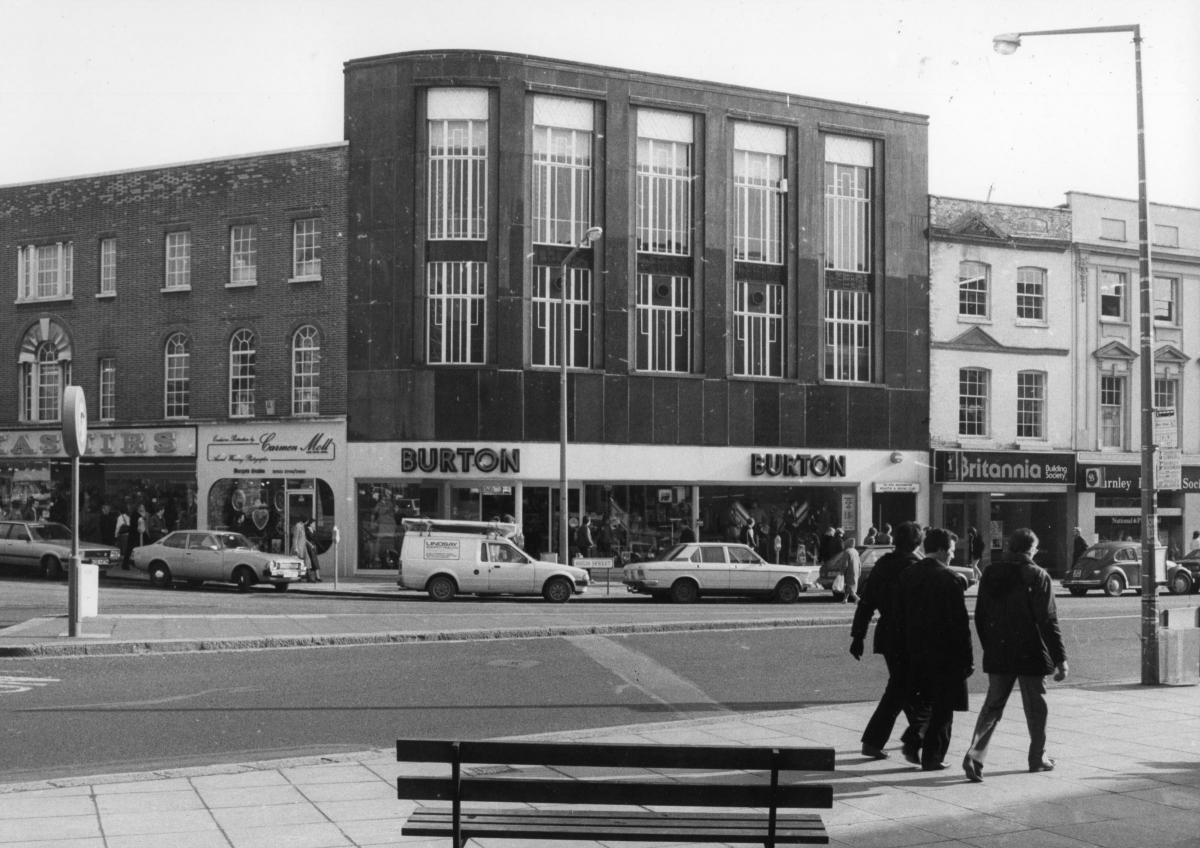
High Street is thrumming with everyday late-twentieth-century activity in this image from 1983, thanks to the boxy-shaped cars driving down the road and numerous shoppers darting between businesses.
The Art Deco frontage of Burton’s menswear store is a neat, orderly cornerstone in this hubbub.
The dark, modernist cladding and elegant, elongated upper windows of the building joined mainstays like the Britannia Building Society to shape the architectural character of this section of High Street.
There’s something deeply ironic in looking back on this scene today in light of the ever-evolving cityscape.
Within a few years of the photo being taken this view was dramatically changed to the rear of the shops by the construction of the Bargate Shopping Centre which opened in 1989 radically altering the flow of the city in the process.
In a twist of urban fate, while that sprawling shopping complex has already been and gone, the centre was demolished in recent years to make way for the new Bargate Quarter development, the handsome Art Deco frontage of the Burton building was spared the demolition ball.
A stoic, historic survivor, surveying over a High Street which seems set on endlessly reinventing itself.
Otterbourne and Shawford

Suspended high over the Hampshire countryside, this 1983 aerial view records the rural confines of Otterbourne and Shawford in a quiet moment of transition.
Rectangular field boundaries and the sweeping curve of the old A33 bypass, a dual carriageway that would, some twelve years later, be spectacularly supplanted by the controversial completion of the M3 motorway, dominate the landscape.
To the mid-left, the distinctive, industrial outline of the Otterbourne Waterworks marks the trees; although this facility remains a vital element of the modern infrastructure, supplying water to the region to this day, the 1980s administrative blocks and older treatment plant structures pictured here, have since been extensively refurbished and reused.
While the basic geography and the leafy, historic village centres still have much of that verdant character today, the broader picture has changed significantly in the last forty years.
The large green buffers seen in the wide view have seen some infill development as housing needs spread out from Winchester and Chandler's Ford.
Seen from this photograph's perspective, the relatively scanty isolated clusters of residential streets among the woodlands are a wistful apparition for any contemporary observer of an area that has since been consumed by the breakneck proliferation of modern suburbia; the picture captures the landscape at a point where the open rolling countryside was still overwhelmingly dominant.
Read more:
-
Thousands came out in full support with street parties 15 years ago
-
How Hampshire celebrated the royal wedding 15 years ago in pictures
-
Man attacks pub landlord after being told bar had only minutes to close
Asda Totton opening

Bright photographs of Totton Asda's 1983 opening day showcase a time when the ribbon-cutting of a 'superstore' was a gala civic occasion.
The outside view is a punch of retail nostalgia, bearing the old sweeping, wave-like Asda logo emblazoned against unmistakably 1980s timber cladding and brick.
Inside is pure retro retail excitement, with a cluster of early-bird shoppers packed around near the tills.
The vintage fashion is plentiful – with smart summer frocks, striped T-shirts and gentlemen in sport jackets, in the days when people still dressed up to attend a new retail destination.

While the act of pushing a wire trolley up and down the aisles is exactly the same today, the look and feel of the supermarket experience has been totally transformed.
The Totton Asda is still a busy staple of the community, but the bright blocky "NoExit" signs, retro slatted ceilings and that memorable wave logo are gone for good - replaced by refined corporate green and modern retail layouts. Yet, looking at the excitement in the eyes of the shoppers clutching their trolleys, the universal excitement of being the first through the doors of somewhere new is exactly the same.
Bitterne Park Triangle

Holding sway over the bustling junction of Bitterne Park Triangle, the ornately carved clock tower stands proud in this 1983 photograph.
Moved to this location in the 1930s, the stone monument remains the indisputable heart of the community to this day.
Looking beyond the lone pedestrian and the vintage streetlights, the essential geometry of the Triangle - the curving junction and the leafy canopy that frames the tower - is instantly familiar to anyone that lives in or passes through the area today.
It still has that very recognisable "village within a city" feel that has always epitomised this beloved corner of Southampton.
Yet look a little more closely at the peripheries and it becomes apparent that it's been more than 40 years since this photo was taken.
The shop fronts in the background are a nostalgic roll-call of 1980s local retail, with the old sight of Spar alongside now-vanished names such as Lankester & Crook grocers.
Today, the traditional retail units now contain a mixture of modern bakeries, cafes and independents.
Elsewhere, the boxy vehicles, the pair of classic telephone kiosks huddled by the trees, and the simple metal bus shelter have been replaced by modern alternatives - but the clock tower's old stonework ensures the Triangle's old spirit is still present as ever.
Buckler’s Hard

While photographs of Southampton from 1983 show a region swiftly modernising its shopping and infrastructure, this tranquil portrait of Buckler’s Hard is telling a starkly different tale.
Resting pretty on the banks of the Beaulieu River, this historic hamlet is all about its wide green high street, originally set out like this to allow space for huge felled timber logs to be rolled down to the water for 18th-century shipbuilding.
Georgian brick cottages sit in rows with the free-roaming New Forest ponies nonchalantly munching grass by the gravel path’s edge.
It’s metropolitan Southampton’s pastoral antidote, frozen in time, and peacefully oblivious to that expanding concrete tide, just up the road.
If you walked down this very path today, this would be almost exactly your view.
Proudly curated by the Beaulieu Estate as a living village and a maritime museum, Buckler's Hard has been preserved in aspic.
The historic houses are substantially unchanged, the ghosts of the shipbuilders who constructed ships for Nelson's navy still haunt the peaceful site and the ponies continue to munch away, untroubled, as ever.
In a part of the world where building comes and old buildings are knocked down and replaced all too often, it is still a beautiful, unperturbed constant.
Read more:
-
Brutal stabbing in car park described as 'sad and pathetic story'
-
Revisit memorable Preston v Saints showdown from Championship era
Fareham

This busy street scene in Fareham gives a fascinating window in the the olden days of high street shopping caught most clearly in the presence of the B&Q "D.I.Y Supercentre."
In those pre-super, out-of-town warehouse retail parks that we're so used to today of 1983, buying timber, paint and garden supplier meant a trip right into town.
The scene is very typical of 1983 with a cyclist peddling down the road alongside a boxy family saloon, as well as the public telephone box on the pavement outside the estate agents.
Although the basic architectural footprint of this stretch is still recognisable, with its tell-tale clash of flat-roof, mid-century commercial blocks bumping up against the older, pitched-roof buildings, the mix of retail on offer has seen a tectonic shift.
Those big high street hardware names are long since gone to the suburbs, while the shop fronts themselves have been completely reworked to house modern cafes, charity shops and retail chains.
Despite the shifting signage and updated cladding though, the basic purpose of the street as a busy, indispensable artery of local Fareham life is identical today to what it was four decades ago.
Hanover Buildings

This lively view down Hanover Buildings captures the everyday rhythm of Southampton's city centre in the early 1980s.
Pedestrians confidently stride across the junction, their long coats and sharp tailoring firmly anchoring the scene in its era, while the boxy silhouettes of period cars queue patiently at the traffic lights.
On the right, the grand, arched upper windows of the traditional brick facades look down over a busy row of storefronts, all subtly leading the eye toward the mature trees of the central city parks looming in the background.
Strolling down this exact stretch today, you will find that the fundamental architectural skeleton of the view remains remarkably intact - with the exception of Debenhams in the background.
Those distinct arched windows still proudly overlook the street, and the greenery of Houndwell and Palmerston Parks continues to provide a natural, calming backdrop to the urban hustle.
However, the mechanics of the street have evolved; the road layout has seen various redesigns over the years to prioritise modern bus routes and pedestrian flow, and the shopfronts have turned over many times to reflect the shifting tides of retail.
Yet, as an essential artery connecting the heart of the shopping district to the city's beloved green spaces, its vibrant, transitory energy remains entirely unchanged.