

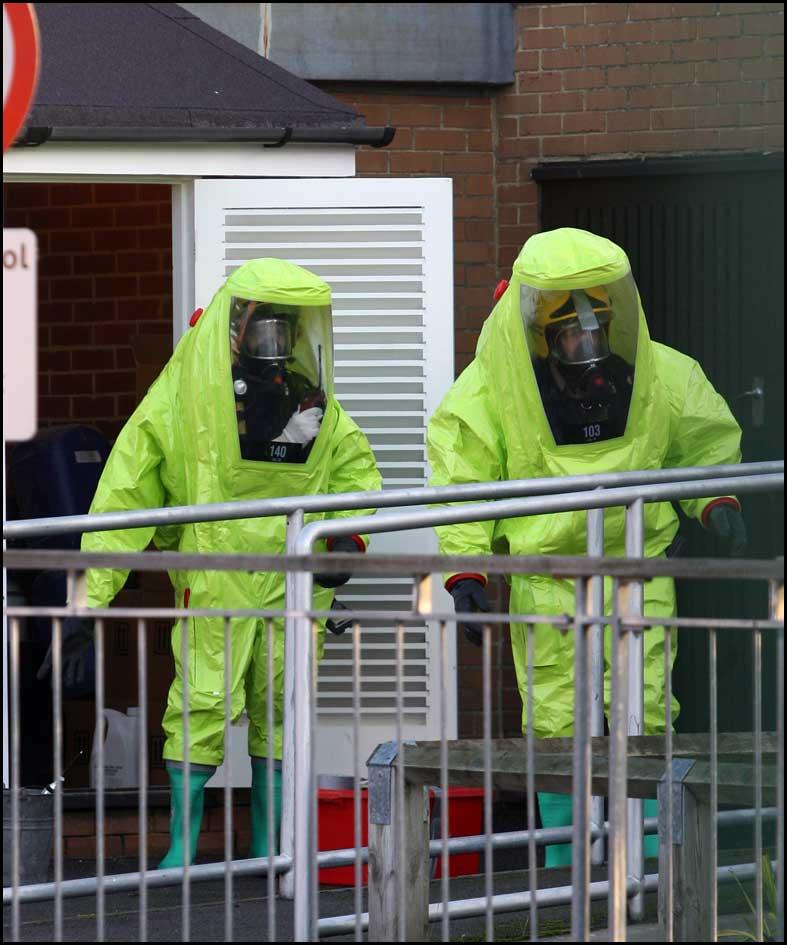
School closed after mustard gas leak (From Daily Echo)
When news happens, text SDE and your photos or videos to 80360. Or contact us by email and phone.
Wildern School in Hedge End closed after mustard gas leak
9:00am Friday 9th December 2011 in News
By Bethan Phillips, Reporter
HIGHLY-toxic mustard gas leaked into a Hampshire school this morning, causing it to be evacuated and closed.
The chemical spillage happened at Wildern School in Wildern Lane, Hedge End, because of a burst pipe.
It is understood that chlorine from the school's swimming pool mixed with another chemical and caused mustard gas, which can cause severe burns, to be produced.
No children were in the school at the time, but staff were evacuated when the leak was discovered, shortly after 7am this morning.
Pupils turning up for school were directed to the furthest building away from where the spill happened and arrangements were made to send them home.
No one was injured by the gas, but an ambulance was called as a precaution.
The school, which has 1855 pupils, will be shut for the day.
Firefighters donned specialist chemical suits to deal with the spill, and experts have been called in to assist the school with a full clean up.
Headteacher Mary-Lou Litton said: "We had a burst pipe in the plant area which has mixed with something and lead to a chemical reaction which has produced some mustard gas.
"A member of staff noticed first thing this morning - it obviously happened over night.
"Fortunately we've got wonderful systems in place to deal with this kind of thing and the emergency services have been fantastic."
The school, which is a co-educational comprehensive, is still assessing the situation, but expects to reopen on Monday.

Comments(21)
AndyAndrews
says...
10:17am Fri 9 Dec 11
hulla baloo
says...
10:41am Fri 9 Dec 11
Torchie1
says...
10:41am Fri 9 Dec 11
Torchie1
says...
10:45am Fri 9 Dec 11
hulla baloo wrote:In the second half of WW1, the British used far more poison gas that the Germans because the facilities existed for far higher production.
Considering it was used as a poison by the German army in WW1, and the fact that a school is involved,why do you consider this an over-reaction?
forest hump
says...
10:46am Fri 9 Dec 11
Mum_of_2
says...
2:21pm Fri 9 Dec 11
fedupwithidiots
says...
3:27pm Fri 9 Dec 11
forest hump wrote:I think you might be under estimating the potential seriousness of the incident! If 2 of the chemicals that are used to keep the pool clean mix out of water then they become deadly, hence the fire brigade taking such precautions! So Forest Hump, back in your box!
Total sensationalism. Little bit of bleach mixing with "something?"...
try air. Pongs a bit but not a real issue
chrisdemeanour
says...
4:18pm Fri 9 Dec 11
Paramjit Bahia
says...
5:17pm Fri 9 Dec 11
Mum_of_2 wrote:Very true
Sorry, but surely in a situation like this it is better to be safe than sorry. If this article had read that the leak had injured children you would all be critisicing the school and emergency services. They cant win in some of your opinions. I am glad they were cautious.
.
Head teacher made the right decision deserves appreciation.
lisaholbury
says...
5:29pm Fri 9 Dec 11
AT LEAST NO ONE WAS HURT!!!!!
Totton Tim
says...
5:44pm Fri 9 Dec 11
X Old Bill
says...
6:59pm Fri 9 Dec 11
Mustard gas contains atoms of chlorine but the manufacturing process is a long way from accidental.
I believe that most swimming pool treatment plants use sodium hypochlorite rather than pure chlorine.
While pure chlorine gas dissolves in water it tends to react with skin and hair and can be very unpleasant if swallowed.
I would guess that one of two things has occurred:
The sodium hypochlorite has reacted with something to release chlorine gas - In high concentrations, when inhaled, chlorine dissolves inside the body and makes an acidic compound.
OR; The sodium hypochlorite has reacted with cleaning chemicals and produced a toxic volatile compound (but not mustard gas).
.
Chlorine was the gas mainly used by the British in WW1 and they only started to use mustard gas when they captured German stockpiles.
forest hump
says...
9:35pm Fri 9 Dec 11
fedupwithidiots wrote:Deadly....please! Go study chemistry! My box is nice and comfy thank you.
forest hump wrote: Total sensationalism. Little bit of bleach mixing with "something?"... try air. Pongs a bit but not a real issueI think you might be under estimating the potential seriousness of the incident! If 2 of the chemicals that are used to keep the pool clean mix out of water then they become deadly, hence the fire brigade taking such precautions! So Forest Hump, back in your box!
Cookiequeen3
says...
10:28am Sat 10 Dec 11
markofhants
says...
5:13pm Sat 10 Dec 11
Scrutinizer
says...
10:49am Sun 11 Dec 11
Sir Ad E Noid
says...
7:51pm Sun 11 Dec 11
Sir Ad E Noid
says...
7:57pm Sun 11 Dec 11
Today, an improved version of this method, known as the Hooker process, is the only large scale industrial method of sodium hypochlorite production. In the process, sodium hypochlorite (NaClO) and sodium chloride (NaCl) are formed when chlorine is passed into cold and dilute sodium hydroxide solution. It is prepared industrially by electrolysis with minimal separation between the anode and the cathode. The solution must be kept below 40 °C (by cooling coils) to prevent the undesired formation of sodium chlorate.
And if you got your heads around that, try this:
Household bleach sold for use in laundering clothes is a 3-6% solution of sodium hypochlorite at the time of manufacture. Strength varies from one formulation to another and gradually decreases with long storage.
A 12% solution is widely used in waterworks for the chlorination of water, and a 15% solution is more commonly used for disinfection of waste water in treatment plants. Sodium hypochlorite can also be used for point-of-use disinfection of drinking water. Taken off the net.
Scrutinizer
says...
8:05pm Sun 11 Dec 11
Sir Ad E Noid wrote:Speak English, Doc, we ain't scientists! ;-)
How you make sodium hydrochlorite: Today, an improved version of this method, known as the Hooker process, is the only large scale industrial method of sodium hypochlorite production. In the process, sodium hypochlorite (NaClO) and sodium chloride (NaCl) are formed when chlorine is passed into cold and dilute sodium hydroxide solution. It is prepared industrially by electrolysis with minimal separation between the anode and the cathode. The solution must be kept below 40 °C (by cooling coils) to prevent the undesired formation of sodium chlorate. And if you got your heads around that, try this: Household bleach sold for use in laundering clothes is a 3-6% solution of sodium hypochlorite at the time of manufacture. Strength varies from one formulation to another and gradually decreases with long storage. A 12% solution is widely used in waterworks for the chlorination of water, and a 15% solution is more commonly used for disinfection of waste water in treatment plants. Sodium hypochlorite can also be used for point-of-use disinfection of drinking water. Taken off the net.
X Old Bill
says...
8:20pm Sun 11 Dec 11
Scrutinizer wrote:Using the internet - isn't that cheating?
Sir Ad E Noid wrote:Speak English, Doc, we ain't scientists! ;-)
How you make sodium hydrochlorite: Today, an improved version of this method, known as the Hooker process, is the only large scale industrial method of sodium hypochlorite production. In the process, sodium hypochlorite (NaClO) and sodium chloride (NaCl) are formed when chlorine is passed into cold and dilute sodium hydroxide solution. It is prepared industrially by electrolysis with minimal separation between the anode and the cathode. The solution must be kept below 40 °C (by cooling coils) to prevent the undesired formation of sodium chlorate. And if you got your heads around that, try this: Household bleach sold for use in laundering clothes is a 3-6% solution of sodium hypochlorite at the time of manufacture. Strength varies from one formulation to another and gradually decreases with long storage. A 12% solution is widely used in waterworks for the chlorination of water, and a 15% solution is more commonly used for disinfection of waste water in treatment plants. Sodium hypochlorite can also be used for point-of-use disinfection of drinking water. Taken off the net.
At least I use books to assist my memory.
I have heard that a pump or two is needing to be replaced - that could suggest a joint or gland broke and allowed a simple leakage of sodium hypochlorite from the system inside the plant room.
.
I always used to be amused by the old bleach adverts which claimed that the product 'Kills 99% of all known household germs' - What about the 1%, and What about the 'unknown' germs? What if the germs are not house-trained?
dango says...
9:48am Fri 9 Dec 11